
How to Build the Right Mindset & Motivation for Weight Loss (Without Burning Out)
If you’ve ever started a diet, felt great for three days, then quietly quit by the end of the week, your mindset and motivation are the actual problem, not your willpower. And here’s the thing: fixing that doesn’t have to be some big dramatic overhaul.

Key Takeaways
| Question | Answer |
|---|---|
| What is the biggest mindset mistake people make? | Thinking in all-or-nothing terms. One bad day doesn’t erase your progress. |
| Why does motivation keep failing people? | Because motivation is emotion-driven, not habit-driven. You need systems, not feelings. |
| What is the Intention-Behavior Gap? | It’s the scientific term for knowing what to do but still not doing it. Around 20% of adults struggle with this chronically. |
| Does mindset affect weight loss results? | Absolutely. Your approach to mindset and motivation directly shapes how consistent you are, which drives results. |
| What helps with motivation for people over 30? | Low-effort systems, realistic goal setting, and strategies tailored to how your body actually works after 30. |
| How many food decisions does the average person make daily? | Over 221 per day, but they only consciously notice about 15 of them. |
| What’s the smartest first step? | Take the weight loss procrastination assessment to identify your specific mental block. |
—
Why Mindset & Motivation Matter More Than Your Diet Plan
Here’s something that nobody tells you enough: the most perfectly designed diet in the world means nothing if your head isn’t in it.
You can have the best meal plan, the right workout schedule, and a fully stocked kitchen. But without the right mindset and motivation, you’ll find a reason to quit by week two.
Research consistently shows that the mental side of weight loss is what separates people who get lasting results from those who stay stuck in a loop of starting and stopping.
The good news? Mindset is a skill. You can build it, tweak it, and improve it without it feeling like a full-time job.
—

How to Spot the Mindset Patterns That Are Holding You Back
Before you can fix your motivation, you need to know what’s actually breaking it.
Most people assume their problem is laziness. In practice, that’s rarely true. What looks like laziness is usually a combination of decision fatigue, unclear goals, and an all-or-nothing thinking pattern that makes quitting feel inevitable.
Here are the most common mindset traps we see:
- All-or-Nothing Thinking: “I ate one bad meal, so the whole week is ruined.”
- Delayed Starting: “I’ll start on Monday.” (Every week, forever.)
- Perfectionism Paralysis: Waiting for the “perfect” plan instead of starting now.
- Identity Mismatch: Not seeing yourself as someone who can actually do this.
- Outcome Obsession: Focusing only on the scale number instead of the daily habits.
If any of those hit home, you’re not alone. About 20% of adults are chronic procrastinators when it comes to health goals, according to behavioral research.
The smartest thing you can do right now is use our weight loss procrastination assessment to identify exactly which pattern is running your brain.
—
The All-or-Nothing Mindset: How to Break Free From It (For Good)
The all-or-nothing mindset is probably the single biggest motivation killer out there.
It convinces you that unless you do everything perfectly, you’ve failed. And once you’ve “failed,” the brain goes into full shutdown mode and tells you to start over next week.
Here’s how to fix it:
- Replace “I failed today” with “I made one choice I didn’t love, and I’m moving on.”
- Score your days on a percentage, not a pass/fail basis.
- Set minimum standards (not ideal ones) for hard days. Did you drink water? Walk a bit? That counts.
- Stop treating Monday as the only valid restart day. Today works.
This shift alone, from binary thinking to flexible progress tracking, is what keeps people going when motivation dips.
And motivation always dips. That’s normal. What separates people who succeed is having a system that runs even when the feeling isn’t there.
—
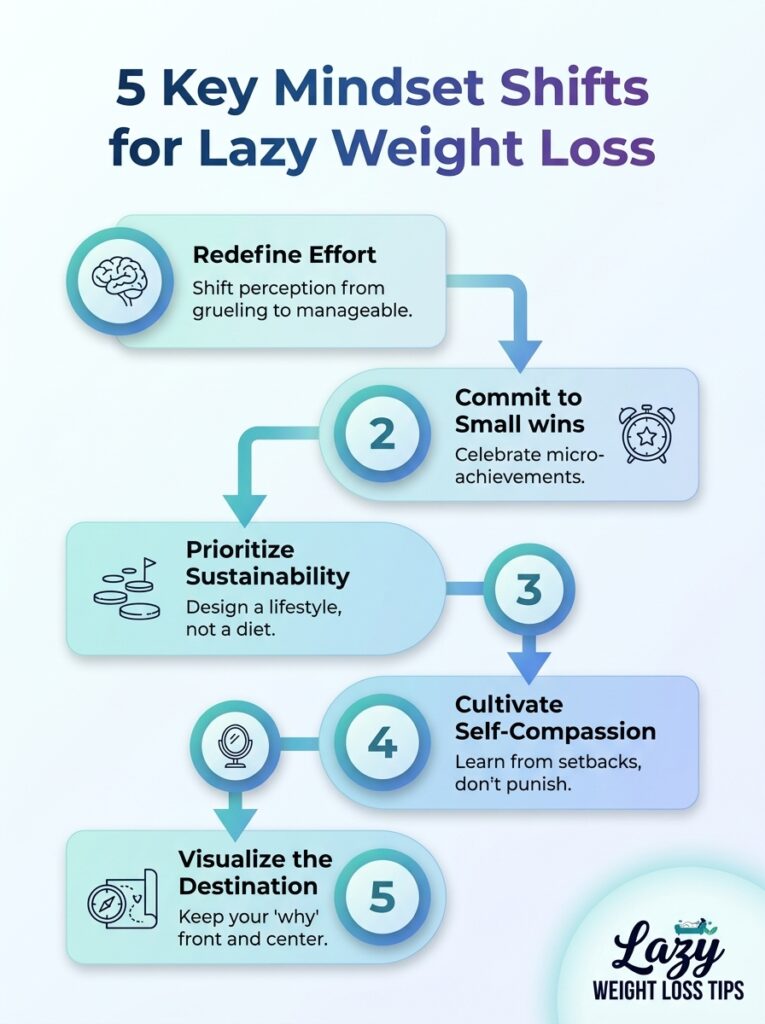
Discover the five mindset shifts that can transform your weight-loss journey. Each shift focuses on motivation and sustainable results.
—

How to Build Motivation That Doesn’t Disappear After a Week
Here’s a stat that changes the whole conversation: motivation is not a personality trait. It’s a state.
That means it comes and goes. Counting on it to show up every morning is the reason most people quit.
What actually works is building a system that doesn’t rely on how you feel. Here’s the framework:
| Strategy | Why It Works | Effort Level |
|---|---|---|
| Micro-habits | Too small to skip, builds momentum | Very Low |
| Habit stacking | Attaches new behaviors to existing ones | Low |
| Identity-based goals | Changes how you see yourself, not just what you do | Low to Medium |
| Progress journaling | Makes wins visible, keeps motivation anchored | Low |
| Environment design | Removes friction from good choices, adds it to bad ones | Very Low |
We’ve said it once and we’ll say it again: the goal isn’t to find more motivation. The goal is to need less of it.
—
Mindset & Motivation Strategies for Weight Loss for Men and Women Over 30s: Keto Diet, Popular Diets, Tips and Strategies That Actually Work
Here’s something that might surprise you: the mental approach to weight loss shifts significantly once you’re in your 30s and beyond.
Your metabolism changes. Your schedule changes. Your responsibilities change. And the diet advice aimed at 22-year-olds just doesn’t land the same way anymore.
For weight loss for men and women over 30s, the keto diet and other popular diet strategies work best when paired with a realistic mindset from the start. That means:
- Accepting that results may come slower, and that’s not a failure.
- Choosing sustainable approaches over crash diets.
- Understanding that your metabolism science is working differently after 30, and adjusting expectations accordingly.
- Building habits that fit into a busy adult life, not a college schedule.
The keto diet and other popular diets can absolutely work, but only if your mindset is set up for consistency rather than perfection.
The tips and strategies that stick are the ones you can actually keep doing when life gets in the way, and life always gets in the way.
—
How Micro-Habits Repair Your Mindset Without Feeling Like Work
If you’ve ever felt overwhelmed at the thought of “getting healthy,” micro-habits are your best friend.
A micro-habit is a behavior so small it feels almost ridiculous. Drink one glass of water before coffee. Walk to the end of the driveway. Do two minutes of stretching. That’s it.
Here’s why they work so well for mindset and motivation:
- They bypass the brain’s resistance to change.
- Every completed micro-habit gives you a tiny win, and wins build confidence.
- Over time, small habits compound into big results without the burnout that comes from trying to do too much at once.
- They work even on the days when motivation is basically zero.
Think of micro-habits as the lazy person’s secret weapon for building momentum. You can explore more smart workouts that work on the same low-effort principle.
“The hardest part of health isn’t the calorie counting or the treadmill. It’s the mental gap between knowing what to do and actually doing it.” — Lazy Weight Loss Tips
—

How to Use the Intention-Behavior Gap to Work Smarter, Not Harder
The Intention-Behavior Gap is the scientific name for something you’ve definitely experienced: knowing exactly what you should do and still not doing it.
Researchers call it the gap between intention and action. It’s one of the core reasons that mindset and motivation techniques fail when they only focus on “wanting it more.”
Here’s how to close that gap:
- Implementation intentions: Instead of “I’ll exercise more,” say “I will walk for 10 minutes after lunch on Tuesday and Thursday.” The specificity removes the need to decide in the moment.
- If-then planning: “If I feel like skipping my walk, I’ll do 5 minutes instead of zero.” This lowers the bar when energy is low.
- Reduce the decision load: Prep your environment in advance so good choices are the path of least resistance.
- Use accountability cues: Visible reminders that trigger behavior without relying on memory or mood.
You can dive deeper into your specific procrastination patterns using the procrastinator’s health and wellness glossary, which breaks down the psychology behind common behavioral blocks.
—
Mindset & Motivation Tips Specifically for the Chronic Procrastinator
Let’s be real: some of us aren’t just occasionally unmotivated. We are structurally, consistently, professionally good at putting things off.
And that’s okay. But it does require a different approach to building mindset and motivation than the “just believe in yourself” advice you see everywhere.
What actually works for chronic procrastinators:
- Set a 2-minute rule: if the action takes under two minutes, do it right now.
- Remove the option to delay by scheduling specific, calendar-blocked time for health actions.
- Identify your procrastinator profile (perfectionist, overwhelmed, low-energy) and build your plan around it, not against it.
- Track only the actions you completed, not the ones you missed. Forward-facing data feels better and builds more momentum.
The tips and strategies that work for procrastinators are about lowering activation energy, not raising motivation. That’s a crucial distinction.
—

How Decision Fatigue Destroys Your Motivation (And How to Fix It Fast)
Here’s a stat that changes the whole conversation: the average person makes over 221 food-related decisions every single day, but only consciously notices about 15 of them.
The other 206 are running on autopilot. And that autopilot is shaped entirely by your environment, your habits, and your mental load at any given moment.
When your brain is already exhausted from decisions at work, at home, and in daily life, your mindset and motivation for healthy choices drops sharply by evening.
Here’s how to fight decision fatigue:
- Do your most important health actions in the morning before the day drains you.
- Batch your meal decisions on Sundays to eliminate daily choices. Our effortless meal prep guides make this simple.
- Set up default meals for busy nights so you’re never making stressed decisions about food.
- Reduce the number of options in your environment to avoid choice paralysis.
That’s actually great news for lazy people. The less you have to decide, the more consistently your habits run on their own.
—
How to Track Your Mindset Progress (Not Just the Number on the Scale)
Most people only track weight. That’s a problem, because the scale doesn’t capture whether your mindset and motivation are actually improving.
And mindset improvement is what drives every long-term result you’ll ever get.
Track these instead (or alongside the scale):
- How many days this week did you stick to your smallest habit?
- Did you recover from a bad day without quitting entirely?
- How often did you choose a lower-effort healthy option over nothing?
- Did your energy levels improve during the week?
- How did you talk to yourself after a rough day?
You can also use the metabolic age and BMR calculator to give yourself a data point beyond the scale, one that actually tells you something useful about how your body is performing.
For people focused on weight loss for men and women over 30s, tracking mindset alongside keto diet progress, popular diets results, or general tips and strategies gives you a much more complete picture of what’s working.
—

How the Right Lifestyle Mindset Supports Long-Term Results
Short-term motivation gets you started. A lifestyle mindset keeps you going for years.
The difference is subtle but critical. Short-term thinking says “I need to lose 15 pounds by summer.” Lifestyle thinking says “I’m building habits I’ll actually enjoy and sustain.”
Here’s how to shift into a lifestyle mindset:
- Stop using time-pressure goals as your only motivator.
- Find at least one healthy habit you genuinely don’t hate doing.
- Focus on how you feel day-to-day, not just what the scale says monthly.
- Look at your longevity and lifestyle goals as the big-picture framework, with weight loss as one part of it.
- Accept that your approach will evolve over time, and that’s progress, not inconsistency.
In 2026, the most successful approach to mindset and motivation combines behavioral psychology, low-effort systems, and a non-punishing attitude toward setbacks.
Calm, steady progress beats intense bursts followed by quitting. Every time.
—
Conclusion
Getting your mindset and motivation right is genuinely the smartest first step you can take in any weight loss journey, especially if you’ve tried and stopped before.
You don’t need more willpower. You need better systems, more realistic expectations, and a way of thinking about progress that doesn’t collapse the moment life gets complicated.
Whether you’re working through popular diets, exploring weight loss for men and women over 30s, figuring out the keto diet, or just trying to find tips and strategies that don’t require you to overhaul your entire life, the mental game is where it starts.
Start small. Track what you do, not what you don’t. Build habits that run on autopilot. And most importantly, let go of the idea that you have to be perfect to make progress.
Let’s fix that mindset. For good.
Ready to find out exactly what’s holding you back? Take the weight loss procrastination assessment and get your personalized procrastinator profile today.